
franz kiekeben
  • Home
  • Blog
  • Philosophy
  • Publications
  • Contact

STEALING FROM GOD: CAUSALITY, PART 2

4/24/2018

0 Comments

 
​The second main point Turek makes in his chapter on causality is that without God, there would be no laws of nature — and therefore no cause and effect:

“Have you ever asked yourself, why are there laws at all?… Why is reality governed by cause and effect? Why are the laws of nature so uniform, precise, and predictable?” 

He says that “Either they arose from a preexisting supernatural intelligence or they did not.” (And he adds that “even Lawrence Krauss recognizes this” — which shouldn’t be surprising, given that those are the only two logical possibilities!) And of the two, the first of course appears to him far more likely: “After all, experience tells us that laws always come from lawgivers.” 

But of course, experience doesn’t teach any such thing. Experience tells us that legal codes come from lawgivers; it does not tell us that laws of nature do. If we had a different word for natural laws — if they were always called, say, natural principles instead — Turek wouldn’t be making this all-too-common mistake. 

He also asks why, given that “all physical things change,” natural laws don’t change — the implication being that materialism cannot explain unchanging laws. But first of all, it’s not necessarily the case that all physical things change. Turek is either counting on the fact that most of his readers will just accept that without really thinking about it, or he himself has not thought about it. The fact that complex entities do change over time does not imply that every one of their components does so as well. Do photons change? Do electrons? Second, and more importantly, laws of nature aren’t “things.” They aren’t physical entities. So even if all physical things did change, that wouldn’t mean the laws would as well. 

Turek, like many theists, believes that atheists have a problem on their hands in that they cannot account for the origin of natural laws. Such laws cannot be explained scientifically because that would necessarily mean appealing to further natural laws, which would also have to be explained, thus leading to an infinite regress. The only possibility, therefore, is that God explains them. 

However, as with so many other theistic arguments, this is just an example of passing the buck. When God says, “let there be light,” light is created — which means there are laws that apply to God’s actions. But if the existence of natural laws requires an explanation, why doesn’t the existence of divine laws do so as well? 

Most theists who become aware of this problem will of course attempt to avoid it by claiming that God is an exception, a necessary being who requires no explanation, and so on. But all they are really doing is introducing the concept of a necessary being (whatever that means) along with baseless claims regarding that being (that it is omnipotent, that it is loving, and so on). The fact is that when it comes to ultimate questions, theists and atheists are in exactly the same boat. Things exist, and they have certain properties. Whether the fundamental nature of things is physical or mental makes no difference: Either way there is something that must be accepted as brute fact. Some theists admit as much. Richard Swinburne, for example, says that “Not everything will have an explanation. But… if we can explain the many bits of the universe by one simple being which keeps them in existence, we should do so — even if inevitably we cannot explain the existence of that simple being.” (Is There a God?, p. 49.) 

We don’t have evidence that God exists. Nor do we have evidence that there is some simple being (even without all of God’s traditional properties) that is the cause of the rest of existence. What we do have clear evidence of is that the physical universe exists — and that it has certain properties rather than others. If there is nothing “deeper” that underlies that fact, then there is no explanation for it. If there is something deeper, we don’t know it yet. And if we do eventually find the “deepest level,” then that will have no explanation. 

Swinburne is wrong, but at least he recognizes we’re all in the same boat. Turek and most theists don't even realize that. They are out at sea, yet believe they’re on solid ground.


[Originally published at Debunking Christianity]
​
0 Comments

STEALING FROM GOD: CAUSALITY, PART 1

4/18/2018

0 Comments

 
Note: This is my second post on Frank Turek’s book, Stealing from God and the first one on his chapter on causality. Since he covers a lot of ground in this chapter, I’ll only deal with his major points.

As we saw last time, Turek conflates atheism with materialism. He therefore claims that atheists must say everything is physical. This of course includes every cause — and from that it follows either that the cause of the physical universe is itself physical, or that the universe doesn’t have a cause. 

The first one can’t be true, however, since there would in that case have to be something physical before there was anything physical. And the second can’t be either, he says, since it makes no sense for the entire universe to just appear causelessly out of nothing. The only option that makes sense is the one atheists reject, namely, that the universe has a non-physical cause. 

Moreover, he continues, atheists’ rejection of non-physical causes is self-defeating. Why? Because their own arguments contain non-physical causes. In case you're wondering what the hell he's talking about (and you should be), he explains what he means with the following jaw-dropping claim: 

“...there is a causal relationship between the premises and the conclusion [of an argument]. In other words, true premises result in valid conclusions.” 

Yes, he actually confuses logical implication with causation. He goes on: “If the law of causality only applied to physical things, then no argument would work because premises and conclusions are not physical things. For any argument to work — including any arguments against God — the law of causality must apply to the immaterial realm because the components of arguments are immaterial.” 

But let’s return to the main argument above. Has Turek succeeded in demonstrating that the universe has a non-physical cause? Of course not. 

Turek maintains that there are only two options here, either that “no one created something out of nothing, which is the atheist’s view," or that "Someone created something out of nothing, which is the theist’s view.” 

But to begin with, it isn’t certain that the universe had a beginning — which it would need to have in order to be created. (It is important to realize that in this context, “universe” means all of reality other than God, if there is a God. That is why the question of a beginning is supposed to be a problem for atheism. Thus, if there is a multiverse, then that is the universe.) Furthermore, even if it did have a beginning, the “atheist’s view” isn’t that the universe was created out of nothing. It is true that some atheists believe that. But that doesn’t make it the view of atheism — nor does it make it right. 

According to atheism, the universe is everything that exists, has ever existed, or ever will exist. Thus, unless self-causation is possible, the universe cannot have a cause. Nor can it come from anything else (as there isn’t anything else). The universe just is. And that’s the case whether or not it had a beginning. 

Moreover, the same thing applies in the case of the theist’s worldview. The totality of existence (whether that’s just the universe or is God plus the universe) cannot have a cause. It did not come from anything. 

But to say it did not come from anything is not to say that it came from nothing, if by the latter one means that it "popped into existence" from a prior state of nothingness, as Turek and many other apologists like to say. The very idea that something came from, or was created out of, nothingness is actually nonsensical, for the very simple reason that nothingness isn’t something — and therefore isn’t something from which anything can come! And note that only in the case of "coming from nothingness" does the universe come into being at all; to say that the universe did not come from anything is to say it simply exists — even if there is a first moment to that existence. 

Those like Turek, who confuse the claim that the universe did not come from anything with the claim that it arose out of nothingness, are making the same mistake as the King in Through the Looking Glass, who, when Alice said she saw “nobody on the road,” replied: “I only wish I had such eyes. To be able to see Nobody! And at that distance too! Why, it's as much as I can do to see real people, by this light!” 

For more on the mistake Turek is making here, see: 

The Reification of Nothing and Follow-Up to Previous Post


[This is a slightly revised version of a post originally published at Debunking Christianity]


0 Comments

STEALING FROM GOD?

4/11/2018

0 Comments

 
Picture
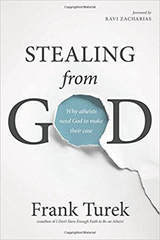
A while back, I was told by a religious critic that I really needed to read Frank Turek’s Stealing from God. Well, I’ve finally accepted the challenge (even if it isn’t much of a challenge) — and thought it might be interesting to write a series of posts as a sort of running commentary on it.

​Turek, though he doesn’t come right out and say so, is a presuppositionalist — he believes that, in order to make any meaningful claims, atheists have to appropriate concepts that only make sense if there is a God. That is why we “steal” from God — and why on his view atheism is self-defeating. 

But even though presuppositionalism strikes me as rather desperate, I have to admit that the idea behind Turek’s book is pretty clever. In six chapters, he considers six areas in which the atheist supposedly steals from the Christian worldview: causality, reason, information and intentionality, morality, evil, and science. These six form (well, almost) the acronym CRIMES – the crimes against theism. 

The problem is that Turek is a very bad judge of the evidence, and that that’s the case is obvious right from the start. In the introduction, he claims that atheists “must make a positive case that only material things exist” — something that would come as a surprise to such atheistic critics of materialism as David Chalmers and Thomas Nagel. Worse, he then lists eleven things that, according to atheism, must be “caused by materials and consists only of materials”: 

The beginning of the universe 
The fine-tuning of the universe 
The laws of nature 
The laws of logic 
The laws of mathematics 
Information (the genetic code) 
Life 
Mind and consciousness 
Free will 
Objective morality 
Evil 

The idea that materialists (much less atheists) must claim that all of these things are caused by, and composed out of, matter is so confused that it’s hard to know how to respond. But since we'll be covering these things in greater detail later, for now I’ll just stick to a few simple points. 

To begin with, materialists don’t have to accept all of the above as real, and many do not. But if there is no such thing as, for instance, objective morality, then obviously objective morality doesn’t have to be explained. 

In the second place, several of the above can in fact be explained in physical terms. The genetic code and life certainly are physical. Presumably, Turek is merely claiming that they cannot have a physical cause. But that, too, is wrong. 

Finally, the idea that given materialism, such things as the laws of logic or of mathematics must be caused by, and be made of, matter is so off base, it’s laughable. But that’s a topic for a future post. 

So far, not a very good start for Turek’s book. 

Next time: Causality. 


​
​[Originally published at Debunking Christianity]


0 Comments

PRESUPPOSITIONALISM AND INDUCTION

5/3/2017

4 Comments


I've previously written about presuppositionalist arguments regarding logic and knowledge. But another one of their arguments concerns the problem of induction. This is the logical problem posed by Hume of how to justify inferences from observed matters of fact to unobserved ones.

Briefly, the problem is this. Consider how you know or are justified in believing that if you (say) let go of a pencil in mid-air under normal circumstances, it will fall. Well, one thing you can point out is that in the past, unsupported pencils, as far as we know, have always fallen – and therefore, it is reasonable to suppose they will continue to do so. This is an inductive inference: from the fact that all observed A's have been B, one concludes that probably all A's – or at least that most A's – are B. However, the fact that pencils have always fallen is logically compatible with one not falling the next time the experiment is carried out, and even with none falling ever again. So how can one justify the inference?

In order to do so, one must maintain that nature is uniform in some way, so that future pencil drops will be like past ones. However, the problem is that the only evidence one has for such uniformity, it seems, is that that's what has been observed so far. In other words, the argument for the uniformity of nature itself appears to be based on an inductive inference. Induction, according to this argument, can therefore only be justified if one first assumes induction. And that, of course, is circular reasoning.

The presuppositionalists claim that atheists cannot justify their acceptance of induction – and that therefore they have no basis for believing in science, among other things. To believe in scientific reasoning on an atheist worldview, they say, one must engage in the above kind of circular reasoning. If on the other hand one starts out with the existence of a God who created a lawful world – a world that behaves in a uniform way – then one's belief in induction is justified. Therefore, only on the theistic worldview can science – as well as everyday inductive inferences – make sense.

This argument may not be quite as bad as the presuppositionalist one regarding deductive logic, but it is still a bad argument, as will now be demonstrated.

To begin with, merely claiming that the justifiability of induction presupposes some x is not so much to solve the problem as it is to ignore it. True, the presuppositionalist might argue that if induction is justified, then there must be a God. But that's not going to convince the induction skeptic. So even if the argument worked, it wouldn't be a solution to the problem.
​

But even worse, if the idea is that one has to accept whatever must be presupposed in order for inductive inference to be justified, then all we need to accept is the existence of a lawful world. The existence of a God who created such a world is superfluous. After all, there is no logical impossibility in the existence of a lawful yet uncreated universe. Thus, one might as well be a presuppositionalist, not with respect to God, but with respect to the uniformity of nature, and then proceed to argue in much the same way as above.

This is sufficient to show that the presuppositionalist argument is wrong. But so far nothing has been said as to why one is in fact justified in making inductive inferences. If a reasonable case can be made in favor of such inferences, it will show that not only is the presuppositionalist argument wrong, but in addition that the main premise it is based on is false.

I think a case logically justifying induction can be made. In fact, I think there are several ways to do this, but here I'll just present what is probably the simplest one.

Consider again the fact that every time a pencil (or any heavier-than-air object) has been let go in mid-air under normal circumstances it has fallen – that is, that all the observed instances of such an event have been like that. What is the best explanation of this fact? Certainly not that it is mere coincidence! It would be statistically impossible for that to be the case. It seems the best explanation is that there is some law of nature that makes such occurrences either naturally necessary or at the very least highly probable. But if that is the best explanation for what we've observed, then we are justified in believing that other instances will very probably be like the observed ones. For if there is an underlying law that explains why all observed pencils, etc., have behaved in this way, then we have good reasons for holding that other objects will do so as well.

Note that this argument does not depend on induction (in the narrow sense with which the problem of induction is concerned). Rather, it is an argument to the best explanation – an abductive argument. It is not that we have observed x many instances supporting uniformity in nature and inductively infer that there will probably be other such instances. It is that the best explanation of there having been that many instances displaying uniformity is that there is an underlying principle that causes such uniformity. Thus, there is a non-circular justification for accepting the existence of laws of nature. And it has nothing to do with God.

Now, presuppositionalists might object that the above argument does not guarantee the correctness of any inductive inference, for two reasons. First, the natural laws that explain the uniformity we've observed might only be probabilistic. They do not necessarily say that the next pencil I let go of will fall, but perhaps only that it is highly likely it will fall. Second, and worse, the existence of the laws themselves has not been proven with certainty, but again only with a high degree of probability. It is much more likely that the uniformity we've observed is a result of natural laws, but it is not strictly speaking impossible that it has all been mere coincidence.

All of that is true. However, that the uniformity we have observed has no explanation is so utterly unlikely that for all practical purposes it can be ruled out. So while it is the case that the argument, even if correct, does not strictly speaking guarantee the existence of laws, it makes the conclusion so probable that we can treat it as certain. And as to the laws themselves being probabilistic, observation shows that if they are (as the standard interpretation of quantum mechanics maintains), they result in events that at the level of everyday objects are so close to deterministic that once again it makes no practical difference. Thus, while it may be true (if the standard interpretation of QM is correct) that an unsupported medium-sized object near the surface of a planet might not fall towards it, the likelihood of such an event happening is so incredibly low that it almost certainly has never happened in the entire 14-billion-year history of our universe.

Now let's compare this with what presuppositionalists themselves can say based on their argument. They believe not only that there is a creator who has made a lawful universe, but that this creator is the God of the Bible – a work they interpret literally, since it is part of God's way of revealing things to us. But in that case, how confident can they be that an unsupported pencil will fall? It's clear that their confidence level should be far, far lower than that based on the above considerations. After all, their God is the author of the natural laws, and can therefore suspend them at any moment. Worse, according to the Bible, he has in fact done so on numerous occasions: among other things, he has turned water into wine, caused a man to walk on water, and stopped the earth's rotation without bringing about the worldwide catastrophe such an event should have caused – and all that in just the last few thousand years! It follows for this reason alone that the presuppositionalist should be considerably less confident than the atheist in making inductive inferences.

But in fact, the presuppositionalist's position is even weaker than that. For, as Michael Martin pointed out, if God can have a morally sufficient reason for allowing natural evils such as cancer and earthquakes, then he could very well have a morally sufficient reason for, say, making it the case that from this moment on pencils will no longer fall – or that they will behave in an entirely random manner. It follows that belief in the biblical God should actually create doubts regarding the justifiability of induction.


Notes:

For Michael Martin's paper on this topic, see: "Does Induction Presume the Existence of the Christian God?" 

Another online paper on this is Alex Malpass's "Induction, God and Begging the Question"


4 Comments

On Matt Slick's Transcendental Argument

3/29/2017

10 Comments

 
For quite some time now, Matt Slick, the president of the Christian Apologetics and Research Ministry (CARM), has been promoting a version of the transcendental argument for the existence of God. About a year ago, that argument was decisively refuted by Alex Malpass, a philosopher at Bristol University. In spite of this, Slick continues to maintain that it has not been refuted and that all Malpass showed is that the argument needs to be reworded. Last I heard, he is still working on an improved version.

In this post, I want to help make it clear exactly what Malpass's objections are, and more importantly, what Slick would have to do to avoid them. For understanding what Slick has to argue to avoid the objections shows the deeper problem with his entire approach.

On his podcast, Slick presented the basic argument as follows:

“...So we have 'God and not-God'. So that's called a true dichotomy. We've got either 'God exists' or 'it's not the case that God exists'... Let's take the no-God position. Can the no-God position account for the transcendental laws of logic? And the ultimate answer is, no it cannot. So therefore, because it cannot, the other position's automatically necessarily validated as being true.”

What Slick is trying to do here – as he himself has often stated – is present a disjunctive syllogism, that is, an argument with the form:

p or q
not q
therefore, p


In addition, he states that his first premise is a dichotomy – that is, that it has the form “p or not-p” – which means that it covers all possibilities, and is therefore necessarily true. That way, he has no need to argue for it.

As he states it, however, his argument is a mess, and so it takes a bit of work to turn it into a disjunctive syllogism. Taken at face value, he appears to be arguing,

1. Either God exists or God doesn't exist
2. Atheism cannot account for the laws of logic
3. Therefore, God exists.


But to begin with, this isn't a disjunctive syllogism; the second premise is not the negation of one of the disjuncts in the first premise. And what's worse is that, as it stands, this argument is clearly invalid.

To turn it into a disjunctive syllogism, we can instead restate Slick's argument as something like the following:

1. Either God accounts for the laws of logic or something else accounts for the laws of logic
2. It is not the case that something else accounts for the laws of logic
3. Therefore, God accounts for the laws of logic.


But now there is a problem with Slick's claim that his first premise is necessarily true. In the above argument, premise one is not a dichotomy. To think so is to confuse:

(A) “Either God accounts for the laws of logic or something else accounts for the laws of logic”

with:

(B) “Either God accounts for the laws of logic or God does not account for the laws of logic.”

Statement (B) is a dichotomy; statement (A) is not, for it does not cover all possibilities. For instance, it ignores the possibility that nothing accounts for the laws of logic.

Now, as it turns out, Slick actually should not be aiming at having a dichotomy as the first premise of his argument. He may think that is the way to go, so as to avoid having to argue for the premise. But as Malpass pointed out, if the first premise were a dichotomy, the argument would simply beg the question. To see why, suppose that we substitute (A) with (B) in the above argument, so that Slick would be arguing something like this:

1. Either God accounts for the laws of logic or God does not account for the laws of logic
2. It is not the case that God does not account for the laws of logic
3. Therefore, God accounts for the laws of logic.


The problem with this is that now the conclusion is just a restatement of the second premise. To say that it is not the case that God does not account for the laws of logic is simply to say that God does account for the laws of logic. In other words, the form of this latest argument is:

p or not-p
not not-p
therefore, p


But to say “not not-p” is just to say “p,” and so the argument becomes:

p or not-p
p
therefore, p


And that's not exactly a good argument.

(There is a more general problem here that Malpass didn't get into, namely, that anytime there is a logically true statement in an argument – like “p or not-p” – it can be removed without altering the argument's validity. Logical truths are not really needed to make arguments go through. This is why the first premise above is redundant, and that all that Slick would be arguing in this case is “p, therefore p.”)

So what can Slick do?

Well, he could try to keep (A) as the first premise and simply stop claiming that it is a dichotomy. However, he now needs to provide us with reasons for accepting that premise.

Let's consider that argument again:

1. Either God accounts for the laws of logic or something else accounts for the laws of logic
2. It is not the case that something else accounts for the laws of logic
3. Therefore, God accounts for the laws of logic.


This first premise is really just saying that something accounts for the laws of logic (whether that is God or not). The argument would therefore be clearer if stated as follows:

1. Something accounts for the laws of logic
2. But if God did not exist, nothing would account for the laws of logic
3. Therefore, God exists.


What Slick must do, then, is show that something must account for the laws of logic (as well as that without God, nothing would). And that's the deeper problem that I alluded to at the beginning.

Now, as Slick himself has said, what he is referring to when he talks about what accounts for logic are the “necessary preconditions” for the existence of logical truths. Or, to put it another way, what must be the case if there are to be logical truths.

One mistake Slick and other presuppositionalists make – though they are certainly not alone in this – has to do with how they understand the relationship between logical laws and that to which they apply. Given the way he argues, Slick must maintain that a rock (say) would not be identical to itself without something else, namely the “law of identity,” making it the case that the rock is identical to itself. But that's simply confusion. That rock is that rock, and that's all it takes for it to be identical to itself. There doesn't have to be in addition a logical truth that brings this fact about, and which in turn has to be accounted for.

Presuppositionalists then compound their mistake by imagining that the logical laws can only exist in the mind of God – which if anything is an even greater confusion.

Logical laws merely describe what must be the case. And since the truths they describe are necessary, there is nothing that they depend on, or even that they could possibly depend on. So not only is God not needed to account for them, but to think that God can account for them is incoherent. Slick's entire approach, then, is misguided.
​

If I had the opportunity, I'd ask Slick if he thinks it is even conceivable that logical truths could fail to hold. Does he, for example, think that (in a godless world) a rock might at the same time both exist and not exist? Or that it might be the case that all human beings are mortal, and that S is a human being, but that S is not mortal?


10 Comments

PRESUPPOSITIONALISM, PART 2 - LOGIC

1/13/2015

0 Comments

 
As explained in part 1, presuppositionalists maintain that without God, there could be no such thing as logic, knowledge, ethics, and several other things besides. Pastor Douglas Wilson, taking this line of thought to a new level of irrationality, even objected to Christopher Hitchens' use of “vibrant and engaging prose” because, as Wilson put it, “If there is no God, then yammer, yamber, yaw&^%...” – and no, that's not a typo. The point of presuppositionalism is to imply that the atheist's worldview is self-defeating: any claim or argument the non-believer makes is rejected as incompatible with non-belief itself.

Here, I want to concentrate on the view that logic presupposes theism, using as my example Sye Ten Bruggencate's defense of this claim, which you can see in the unintentionally humorous “interview” with Eric Hovind titled Episode 2 – Logic.


According to Bruggencate, logic is one of the “fundamental assumptions of the unbeliever.” After all, one cannot conclude that atheism is correct or that religious belief is incorrect without making use of it. The problem, according to Bruggencate, is that atheists cannot justify their use of logic. To do so, they need to use logic itself, and so end up arguing in a circle. His solution is to maintain that God grounds logic and reveals it to us so that we can know that it is justified. As Eric Hovind puts it, “logic is only consistent with the God of the Bible.” (Why the God of the Bible, as opposed to the God of the Koran, or the Flying Spaghetti Monster for that matter, isn't explained.)

One obvious problem with this entire approach concerns how presuppositionalists themselves arrive at it. What is their starting point, their “fundamental assumption,” as Bruggencate might put it? Bruggencate would of course answer that it is God. But clearly that isn't the case. Like everyone else, presuppositionalists make use of logic right from the start. They argue, in other words, as for example when they conclude that the nonbeliever cannot account for logic's validity without circular reasoning, or that God is the only possible foundation for logic because he is eternal and immutable. This isn't to say that their arguments are good ones, of course. They aren't. When Bruggencate points out that the laws of logic are universal, immaterial, and unchanging, and that these same three attributes apply to God as well, he is making a very weak argument by analogy. And his reasoning is even worse when he argues that the atheist cannot account for unchanging logical laws in a universe that is constantly changing. In fact, these arguments are so bad they're laughable. But they are arguments nonetheless, and as such, they presuppose logic. This shows that in order to arrive at the conclusion that God is the source of logic, presuppositionalists must already accept logic.

Now, my point here isn't that the presuppositionalists make a mistake in starting with logic. The mistake they make (besides misusing logic in their flawed arguments) is to suppose that that's not what they're doing – to suppose instead that they are beginning with God. The irony here is that the one thing that one must be a presuppositionalist about, in a matter of speaking, is precisely logic. This is because any claim whatsoever implicitly uses the laws of logic. One cannot say “logic is valid,” or “x is true,” or anything else coherent without presupposing the law of identity, for to say that x is anything is to say something about the thing whose identity is x. Bruggencate may think that he begins with God – that he only accepts logic because God has told him he should – but in order to even think such a thought, he had to use logic.

The laws of logic are necessarily true because what they describe applies to every possible scenario. This is why they are implicit in every statement. And because the laws of logic are necessarily true, logic cannot be contingent upon anything, including God. In Episode 2, Bruggencate says – and this is one of the few instances where he is correct – that logic cannot be man-made, as some atheists claim. If it were, then it might have been different. “Could the universe,” he asks, “have both existed and not existed at the same time and in the same way?” But once again there is a bit of irony here, because in his view there would be no logic without God – and that means that a godless universe could both exist and not exist at the same time. By making logic contingent on God, Bruggencate is no better than those who make it contingent on humans.

One final example of the kind of confusion one gets into by denying the necessity of logic can be seen in how Bruggencate ends up justifying the law of non-contradiction. Logical contradictions, he says, are not allowed “because logical contradictions amount to lying, and God tells us not to lie.” This is such an amazing statement that I can only quote his interviewer and say, “Wow!” According to Bruggencate, the law of non-contradiction is valid for moral reasons! I guess it's just not very nice for the universe to both exist and not exist at the same time: it offends God.


0 Comments

presuppositionalism, PART 1 - KNOWLEDGE

1/8/2015

0 Comments

 
Presuppositionalism states that the existence of God – and more specifically, of the Christian God – is a prerequisite for such things as reasoning, knowledge, and morality. Its real purpose is to prevent other people's arguments from ever getting off the ground. By maintaining that God is presumed in any argument or claim, the presuppositionalist attempts to stop the opponent in his tracks before he even has a chance to get started. Thus, if an atheist says she has a reason why she doesn't believe in God, the presuppositionalist will immediately interrupt to ask how the atheist can justify reasons without God, and if she claims to know that something is the case, the presuppositionalist will object that on the atheistic worldview knowledge isn't possible. The best description of this entire approach I've come across was given by Matt Dillahunty in a debate with presuppositionalist Sye Ten Bruggencate: "Kindergarten theology coupled with kindergarten philosophy, presuppositionalism is the equivalent of sticking your fingers in your ears and refusing to listen to reason." 

Here, I will focus on the argument dealing with knowledge, using Bruggencate's particular version of it as an example. A second post will address Bruggencate's views on logic or reasoning.

Bruggencate argues that knowledge is possible only if an omniscient being is the source of that knowledge, for otherwise one could be mistaken. That is, since our minds are finite, if we are dependent on our own abilities, there could be something we don't know that invalidates what we think we know. It follows, according to this "logic," that in that case we don't know anything. The solution is to have God reveal absolute knowledge to us. And this, Bruggencate argues, is what God has in fact done: we have knowledge, but only because there is a knowledge-giver.

Bruggencate's claim can be broken down into two parts. The first is that without God knowledge isn't possible, and the second is that with God the problem is resolved. As we will see, the argument fails on both counts.

Let's begin with the first part. We aren't omniscient. Does it follow that left to our own devices we wouldn't be able to know anything? Of course not. Knowledge is true belief that is properly justified. If I believe something that is in fact the case and have proper justification for believing it, then I have knowledge. Perhaps Bruggencate and other presuppositionalists imagine that proper justification is impossible without omniscience because they believe that knowledge requires certainty. For instance, I claim to know that the earth is round, yet logically speaking I could be wrong. I might be a brain in a vat in a universe that doesn't even have an earth. Doesn't it follow that I don't really know that the earth is round? No, not at all. For if in fact the earth is round then my belief is true and, since I believe it for the right reasons - namely, the evidence that demonstrates the earth's actual roundness - then I do know that the earth is round. It follows that if the earth really is round, then my belief that the earth is round qualifies as knowledge even though I am not, strictly speaking, certain of it. Knowledge does not require complete certainty.

However, even supposing that it did, Bruggencate's argument wouldn't work, for as it turns out there are things each of us does know with certainty. For instance, I know that the experience I am having at this moment exists, just as you know that about your current experience. One cannot deny that without contradiction. (Bruggencate would of course object that I'm using logic unjustifiably here, but that's something I'll ignore for now since it will be covered in the next post.)

The claim that knowledge is impossible without God doesn't hold up. But if there were a problem here for the atheist, would the introduction of God solve it? Again, the answer is no. For by Bruggencate's own criterion, even if God did reveal something true to us we still wouldn't have knowledge - not unless God also made us omniscient. Remember, Bruggencate maintains, first, that without certainty you don't really have knowledge, and second, that you can't be certain unless you are omniscient. How then does the introduction of God as a source of information change anything? How, in other words, does God impart certainty to us?

I've never seen this difficulty addressed. Bruggencate appears to be unaware of it. However, he might very well reply that, since God himself knows all and can be trusted wholeheartedly, any information he reveals to us is true and properly justified. So, for instance, if God tells us that the earth is round, then we can be certain that it is.

But unfortunately, there is an obvious gap in this argument. By Bruggencate's own standards, one of the things we must know with certainty in order for the above to work is that the information we are receiving (e.g., that the earth is round) in fact comes from an omniscient and wholly trustworthy being. And how would we know that? Bruggencate has two options here: he can say that we know it because God reveals it to us, or he can say that we know it for some other reason. If he answers that we know it because God himself tells us that he is the one imparting the information, then he's caught in an infinite regress: for now the question becomes, how do we know that it is God telling us that it is God imparting the information? If on the other hand Bruggencate says that we know it for some other reason, then he has given up on the entire basis of his argument - namely, that God is the only possible source of knowledge.

Another, simpler, way to see that the argument can't work is by bringing up the brain-in-a-vat thought experiment once more. Could you be a brain in a vat who is fed the information that a god is revealing truths to you? Yes. Then how does Bruggencate know that he isn't in that situation? In other words, how is he in a better position than the atheist?

What all this shows is that if Bruggencate were correct and knowledge required certainty which could only come from omniscience, then we finite minds couldn't know anything, period. His argument therefore fails in every respect. Bruggencate is wrong that without God one cannot have knowledge and he is wrong that God would solve the problem.

His argument with regards to logic, however, is if anything even worse, as I will show in the next post.

0 Comments
Forward>>

    Archives

    October 2023
    April 2022
    May 2021
    April 2021
    March 2021
    October 2020
    September 2020
    August 2020
    May 2020
    April 2020
    March 2020
    February 2020
    January 2020
    December 2019
    November 2019
    October 2019
    September 2019
    August 2019
    July 2019
    May 2019
    April 2019
    March 2019
    January 2019
    December 2018
    November 2018
    October 2018
    September 2018
    August 2018
    July 2018
    June 2018
    May 2018
    April 2018
    March 2018
    February 2018
    January 2018
    December 2017
    November 2017
    October 2017
    September 2017
    August 2017
    July 2017
    June 2017
    May 2017
    March 2017
    February 2017
    January 2017
    December 2016
    November 2016
    September 2016
    August 2016
    July 2016
    May 2016
    April 2016
    March 2016
    February 2016
    January 2016
    December 2015
    November 2015
    October 2015
    September 2015
    August 2015
    July 2015
    May 2015
    April 2015
    March 2015
    February 2015
    January 2015
    December 2014
    November 2014
    October 2014
    September 2014
    August 2014
    July 2014
    June 2014

    Categories

    All
    Atheism
    Creationism
    Determinism And Free Will
    Ethics
    Infinity
    Politics And Religion
    Presuppositionalism

    RSS Feed

Link to my author's page on Amazon